How to Build a Home Gym That Still Gets Used in Year Two
Quick Answer: Home gyms fail for four reasons: the equipment cannot progress with you, the space requires setup before every session, the training has no external structure, and the room is unpleasant to be in. Solving those four matters more than any equipment choice, and the equipment that solves them is usually less than people buy.
The pattern is remarkably consistent. Enthusiastic build, three excellent months, gradual decline, and by month ten it is a drying rack with a barbell under it.
This is not a discipline failure. It is a design failure, and every one of its causes has a fix.
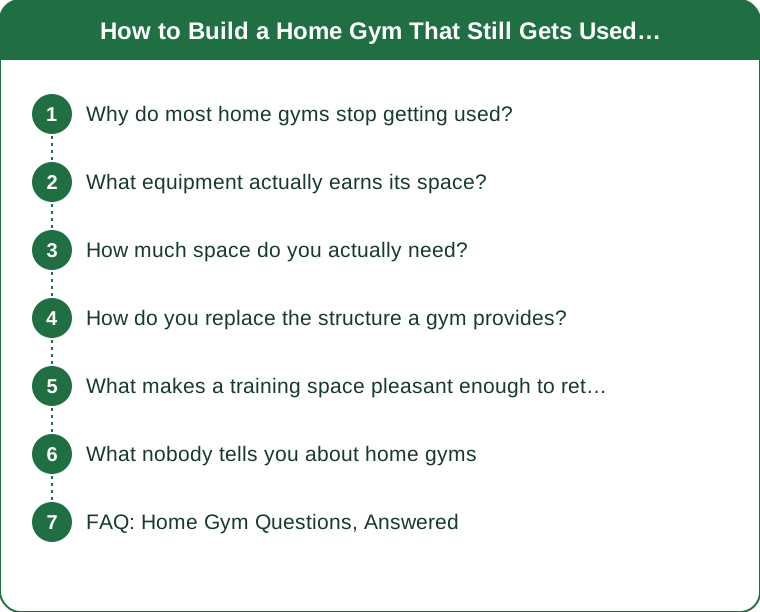
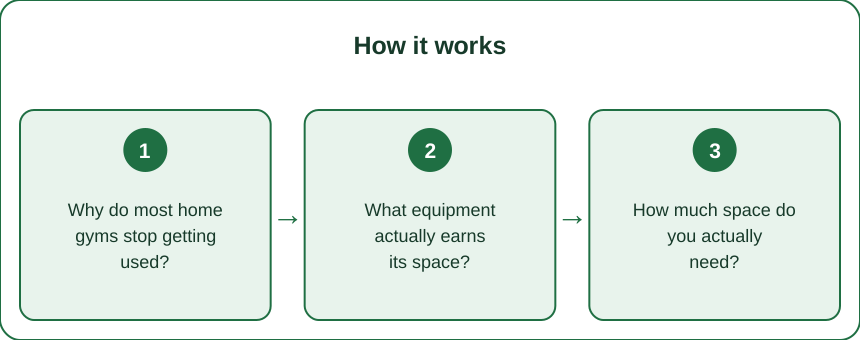
Why do most home gyms stop getting used?
Four causes, and they account for the overwhelming majority of cases.
The progression ceiling. This is the big one. A set of adjustable dumbbells going to 24 kg is genuinely sufficient for a beginner and genuinely insufficient after eight months of consistent training. The moment your working sets exceed the equipment’s range, the sessions stop being effective, and effectiveness is what sustains motivation. People do not stop training because they lost interest; they stop because the training stopped working and they could not name why.
Setup friction. Every step between deciding to train and starting to train reduces the number of sessions you complete. If equipment lives in a cupboard, if the space has to be cleared, if the bar has to be assembled, you have added three to five minutes of activation energy to every session — and on the days when motivation is marginal, which is most days, that is decisive.
Absence of external structure. A gym provides a schedule, a commute that functions as a commitment device, other people, and a class timetable. Home provides none of these. Without a replacement structure, training frequency drifts downward slowly enough that you do not notice until it has stopped.
An unpleasant room. Cold garages in winter, poor lighting, low ceilings, damp. These feel like minor complaints and they are actually decisive, because they turn every session into a small negotiation.
Notice that only one of the four is about equipment.
What equipment actually earns its space?
Ranked by how much use per square metre and per pound it delivers.
Adjustable dumbbells with a high ceiling. The single most versatile purchase. Look for pairs reaching at least 32 kg, and ideally 40. Cheaper sets topping out at 24 kg are the most common source of the progression ceiling problem — they save money for eight months and then need replacing entirely.
An adjustable bench. Unglamorous and enormously enabling. It roughly doubles the exercise options from any set of dumbbells and is essential for pressing variations.
A pull-up bar. Cheap, small, and covers a movement pattern nothing else replicates well.
Resistance bands, a set with varied tensions. Not a substitute for weights, but excellent for warm-ups, accessory work, and travel. Very high value per pound.
A barbell, plates, and a rack — if and only if you have the space and the goals. For anyone serious about strength, this is the ceiling-free option and nothing else compares. It also needs 6 to 8 square metres, a solid floor, and ideally safety bars for training alone. Buying a rack for a space that cannot really take one is the most expensive version of this mistake.
Flooring. Rubber mats protect the floor, reduce noise, and change how the space feels. Consistently underrated.
What rarely earns its space: novelty machines, vibration plates, ab devices, and any single-function item. If it does one exercise, it needs to be an exercise you will do 200 times a year.
How much space do you actually need?
Less than most people assume for dumbbell training, considerably more for barbell work.
Dumbbell and bodyweight training: 4 square metres. Roughly 2 m by 2 m gives room for a bench, floor work, and standing movements with dumbbells overhead. Ceiling height matters — you need your full standing reach plus about 30 cm, so pressing overhead in a room with a 2.1 m ceiling is a problem for anyone tall.
Barbell training with a rack: 6 to 8 square metres minimum, with at least 2.4 m ceiling height for overhead pressing, and ideally 2.6 m. A 2.2 m barbell needs about 3 m of width to load plates comfortably at both ends. Floor loading matters too: a rack plus 150 kg of plates plus a person is a significant point load, which is worth checking on a suspended upper floor.
Cardio equipment: 2 to 4 square metres each, and this is where most home gyms lose their space. A treadmill has a large footprint and a single function. Consider whether you will genuinely use it, given that walking and running outdoors are free.
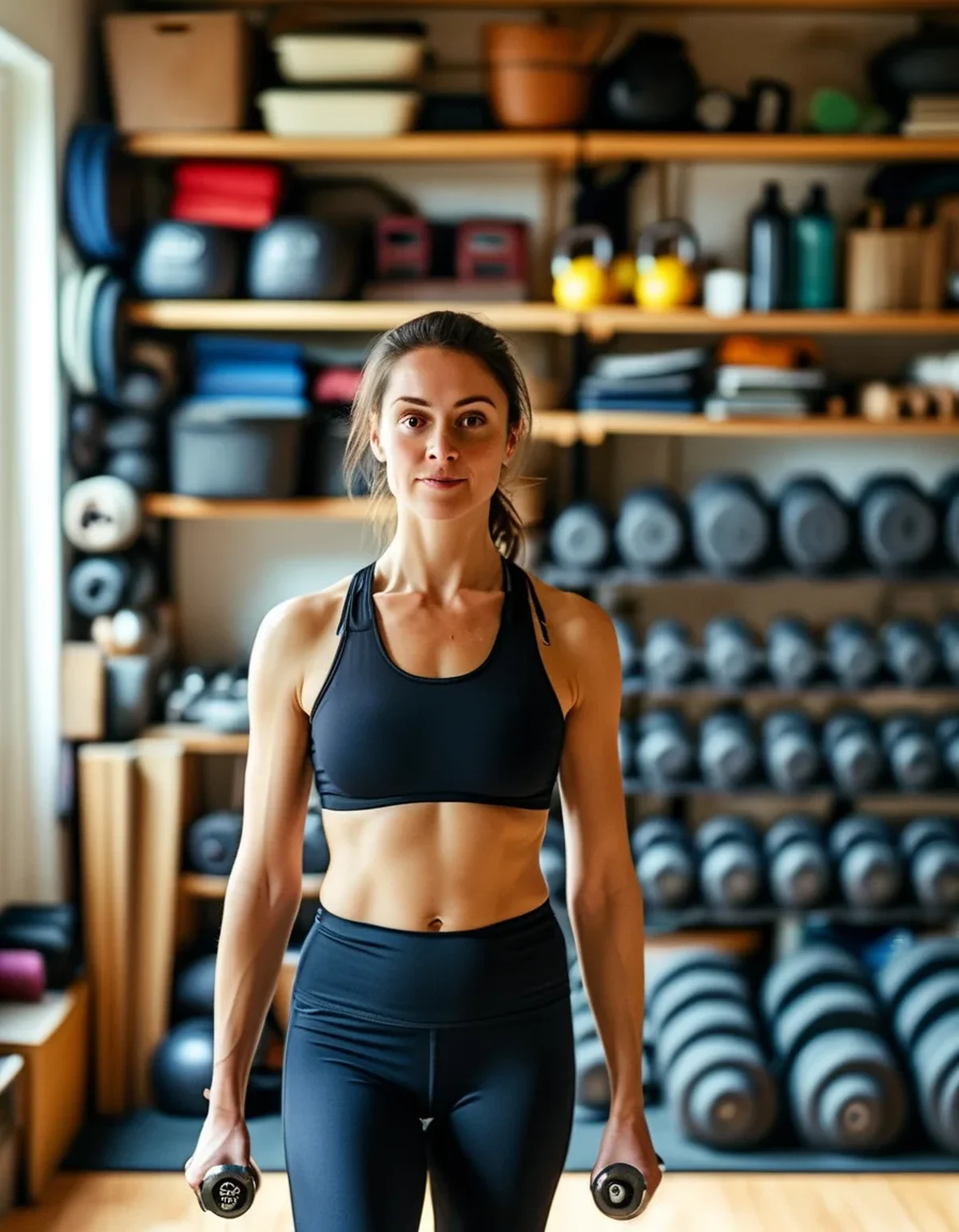
The overlooked dimension is storage. Equipment that does not have a home ends up on the floor, and a floor covered in equipment is a room you avoid. Wall-mounted storage for dumbbells, bands, and plates makes a small space workable in a way that extra floor area does not.

How do you replace the structure a gym provides?
This is where most of the difference between a used and unused home gym actually lies, and it costs nothing.
Train on a written programme, not on daily choice. Deciding what to do at the moment of training is a decision cost, and decision costs get avoided. A programme written for eight to twelve weeks — with specific sessions, exercises, sets, and progressions — removes the choice entirely. This single change resolves more abandoned home gyms than any equipment purchase.
Fix the time, not the intention. “Training four times a week” degrades. “Training at 6:30 on Monday, Tuesday, Thursday, Saturday” survives, because it competes with specific alternatives rather than with everything.
Create an arrival ritual. The commute to a gym does psychological work — it marks the transition into training mode. At home, something has to replace it: changing into training clothes, a specific playlist, a fixed warm-up sequence. Any consistent cue works; the consistency is the active ingredient.
Add external accountability. A training partner over video, a coach reviewing your log monthly, a group chat, a shared spreadsheet. Home training removes every social consequence of not showing up, and adding one back matters more than most people expect.
Log every session. Beyond programme adherence, a log makes progress visible when it is too slow to feel — and invisible progress is a leading cause of quitting.
Keep one thing outside the house. A weekly class, a run club, a lifting session with a friend. It maintains the social dimension of training, which the home gym cannot provide and which is a stronger retention factor than most people admit.
What makes a training space pleasant enough to return to?
The environmental factors that feel superficial and are not.
Light. Poor lighting is the most common complaint about garage and basement gyms, and the cheapest to fix. Bright, even, cool-white light — 4,000 K or above — makes a space feel usable. A single dim bulb makes a garage feel like a storage unit that you train in, because that is what it is.
Temperature. A garage at 6°C in January is a genuine barrier, and no amount of discipline reliably overcomes it for long. A small heater on a timer, run for 20 minutes before the session, resolves it for a modest cost. In summer, a fan matters just as much — training in still, hot air is unpleasant and measurably reduces performance.
Air. Enclosed spaces get stale quickly with one person breathing hard. A window, a vent, or a fan moving air makes a substantial difference to how long you willingly stay.
Sound. A room with hard walls and no soft surfaces is echoey and unwelcoming. Rubber flooring helps considerably; so does anything absorbent on a wall. Music matters too — a permanent speaker in the room removes a step from every session.
Mirrors and visual finish. Optional but effective. A room that looks like a gym gets used like one. A room that looks like a garage with weights in it competes with the garage’s other uses, and the other uses usually win.
Keep it single-purpose if you possibly can. The strongest predictor of long-term use is that the space is not also the laundry room, the storage overflow, or the kids’ play area. Where a dedicated room is impossible, a defined zone with clear boundaries — flooring that marks the edge, dedicated storage — does much of the same work.
What nobody tells you about home gyms
You will train differently at home, and mostly for the better. Sessions get shorter and more frequent, because there is no travel overhead. Three 30-minute sessions at home often beat two 75-minute gym sessions in weekly volume, and the shorter format is far more sustainable around work and family.
The equipment you use most is rarely the equipment you were most excited about. Almost everyone reports that the bench, the dumbbells, and the pull-up bar do 80 percent of the work while the more specialised purchase gathers dust. Buy the boring things first and add the exciting one after six months if you still want it.
Buying used is genuinely fine for most of it. Plates, dumbbells, benches, and racks are simple steel objects that do not degrade meaningfully. The second-hand market is full of eight-month-old home gyms being sold by people who hit exactly the problems this article describes — which is grim and also a good buying opportunity.
Noise carries further than you think in flats and terraces. Dropped weights transmit through structure, not just air. Rubber mats help; controlled lowering helps more; training at reasonable hours helps most.
The most common regret is buying a cardio machine, and the second is buying a light dumbbell set. The most common satisfaction is a rack, among the people who had the space for one.
You will need less than you think, and you will need it to go heavier than you think. That single sentence covers most home gym purchasing errors in both directions.
FAQ: Home Gym Questions, Answered
What is the minimum budget for a genuinely useful setup?
A pair of adjustable dumbbells reaching at least 32 kg, an adjustable bench, a pull-up bar, and some flooring will cover almost everything most people need, and it can be assembled second-hand for a fraction of new prices. Everything beyond that is preference or specialisation.
Should I build a home gym or keep my gym membership?
Consider keeping both for the first six months. Home handles the days you cannot travel; the gym handles heavy work, variety, and the social element. Many people find the honest answer is a cheap gym membership used once a week plus a modest home setup, rather than either extreme.
How do I know if I will actually use it before spending the money?
Train at home for eight weeks with bands, bodyweight, and one pair of dumbbells before buying anything substantial. If you complete those eight weeks at three sessions a week, the problem was never the equipment and you can invest confidently. If you do not, more equipment would not have changed it — the structure needs fixing first.
Is a rack safe to use alone?
With safety bars or straps set at the right height, yes, for most lifts — that is exactly what they are for. Set them every session rather than eyeballing it, and be more conservative with loading than you would be with a spotter present. If you have any medical condition that could cause a sudden loss of consciousness, training alone with heavy loads overhead is not appropriate. This is general information, not medical advice.
TL;DR:
- Home gyms fail from a progression ceiling, setup friction, no external structure, and an unpleasant room — not from lack of discipline.
- Buy adjustable dumbbells that reach at least 32 kg, an adjustable bench, a pull-up bar, and flooring before anything else.
- Dumbbell training needs about 4 m²; a barbell and rack need 6–8 m² and 2.4 m of ceiling.
- Replace the gym’s structure with a written programme, fixed times, an arrival ritual, and one form of external accountability.
- Light, heat, air, and single-purpose space determine whether you keep walking into the room.
The equipment question is the one everybody asks and the least important of the four. A modest setup in a pleasant room with a written programme outlasts a fully-loaded rack in a cold garage every time.
See It in Motion
Seen here: High Waist Yoga Leggings with Side Pockets — shop it on bubblelime.com
Keep Reading
This article is for general informational and styling purposes only. Fit, sizing, and product availability may vary.