The Complete Guide to Powering a Home Gym Without Overloading Anything
Quick Answer: Motorised cardio equipment draws far more current than people expect, and garages and basements are usually on a single lightly-specified circuit shared with lighting and outlets. Add a heater or a large fan and you are at the limit. Plan by adding up the wattage of everything that will run simultaneously, keep treadmills off extension leads, and have an electrician add a dedicated circuit if you are running cardio equipment plus climate control. This is general guidance - electrical work should be done by a qualified electrician.
The breaker trips mid-session. Or the treadmill stutters when the heater kicks in.
Both are the same problem, and both are entirely predictable from the numbers on the equipment labels.

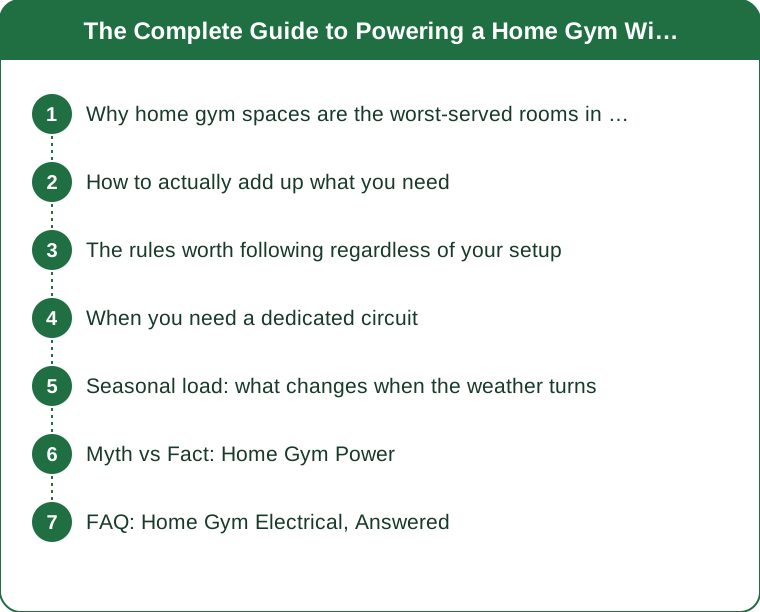
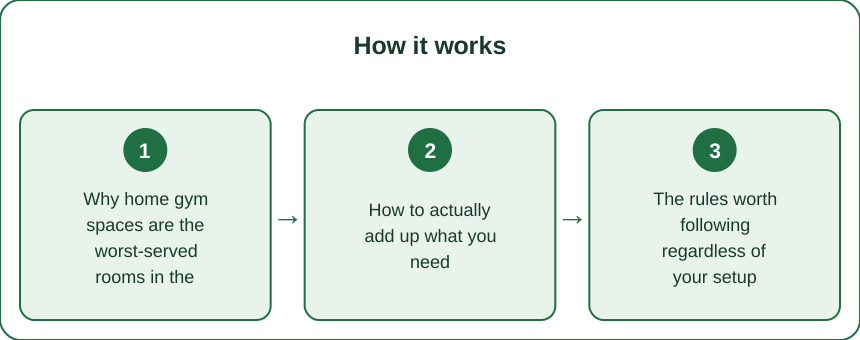
Why home gym spaces are the worst-served rooms in the house
Garages and basements are typically wired as low-demand spaces. When the house was built, nobody anticipated a treadmill, a heater, and a sound system running for an hour at a time in a room designed for storage and a light bulb.
Multiple outlets usually share one circuit. In many homes an entire garage - lights, every socket, and sometimes an outdoor outlet - runs on a single circuit, so the total capacity is shared across everything you plug in.
Older wiring compounds it. Homes wired decades ago were designed around far lower household electrical demand, and a converted space in an older property is the most likely place to find a genuine limitation.
Motorised equipment has a startup surge. The current drawn when a treadmill motor starts, or when a compressor-based heater kicks in, is considerably higher than its running draw - which is why things trip at the moment something switches on rather than during steady use.
Climate control is the usual tipping point. Electric heaters in particular are enormous loads, frequently drawing more than everything else in the room combined, and they are exactly what you add when you start training in a cold garage in autumn.
Extension leads hide the problem rather than solving it. Running a lead from another room can move load onto a different circuit, or can quietly create a new hazard depending on the lead’s rating and length - it is not a substitute for adequate supply.
And the failure modes vary in seriousness. A tripping breaker is an inconvenience and a warning. Warm outlets, warm cables, flickering lights when equipment starts, or a burning smell are not inconveniences, and they mean stop and call an electrician.
How to actually add up what you need
Start by listing everything that will run at the same time. Not everything you own - everything simultaneously powered during a typical session, including lighting.
Find the wattage on each item’s label or manual. It is usually on a plate near the power inlet, in the specifications section of the manual, or on the manufacturer’s website.
Typical figures give you a sense of scale. Treadmills commonly draw somewhere between 600 and 1,500 watts under load. Large fans are usually modest. Electric heaters are frequently 1,500 to 3,000 watts on their own - by far the biggest single item in most home gyms.
Sound systems, lighting, and phone charging are negligible by comparison, and are not where your problem is.
Add the simultaneous total and compare it against the circuit’s capacity. Your consumer unit or breaker panel labels each circuit with its rating, and an electrician can tell you what is on each one if the labelling is unclear or absent.
Leave meaningful headroom rather than planning to the limit. Running a circuit continuously near its rating is not how circuits are meant to be used, and startup surges need room above your steady-state total.
And note that a treadmill’s draw varies with the user and the incline - a heavier load and a steeper incline both raise the motor’s demand, so the figure in the manual is not the ceiling in practice.
The rules worth following regardless of your setup
Plug motorised cardio equipment directly into a wall outlet. Treadmill manufacturers specify this in their manuals, and using an extension lead frequently voids the warranty as well as adding risk.
If you absolutely must use a lead, use a short heavy-duty one rated well above the equipment’s draw. Long, thin, coiled leads are the specific bad case - voltage drops over length and coiled cable does not shed heat.
Never daisy-chain extension leads or power strips. This is the single most common serious hazard in home gyms and it defeats the protection built into each device.
Do not run a heater and a treadmill on the same circuit if you can avoid it. These are the two largest loads in a typical home gym and they are also the two most likely to be running at the same time in winter.
Keep leads out of the training area entirely. A cable across the floor near a rack or a treadmill is a trip hazard in a room where you are moving under load and sometimes moving backwards.
Use outlets with appropriate protection in damp spaces. Garages and basements can be damp, and residual current protection is standard practice for those environments - an electrician will advise what applies where you live.
And check the equipment manual before you buy, not after. Cardio machines list their electrical requirements clearly, and it is far easier to plan a circuit before a treadmill is standing in the room than after.

When you need a dedicated circuit
Any serious motorised cardio equipment is the clearest case. Many treadmill manufacturers explicitly specify a dedicated circuit, and following that is the simplest route to reliable operation and a valid warranty.
Cardio plus climate control together makes it near-certain. If you plan to run a treadmill or rower in a garage that also needs a heater in winter, plan for the electrical work as part of the project rather than discovering the need in November.
Repeated breaker trips are a clear signal, not a nuisance to work around. The breaker is doing exactly its job. Resetting it repeatedly, or - never do this - replacing it with a higher-rated one, converts a protected situation into a dangerous one.
Budget for it in the equipment plan. Adding a circuit is a moderate cost relative to a treadmill, and it is far cheaper than damaged equipment or an electrical fault.
Ask about capacity while you are at it. An electrician can tell you whether your consumer unit has spare capacity, which determines whether adding a circuit is straightforward or a larger job - and that answer shapes how you phase the build.
Consider future equipment when specifying. If you might add a second cardio machine or a sauna blanket later, having that conversation once is much cheaper than having the work done twice.
And this is genuinely not a DIY area. Electrical work is regulated in most places for good reason, and the consequences of getting it wrong are not recoverable. Use a qualified electrician.
Seasonal load: what changes when the weather turns
Autumn and winter are when home gym electrical problems surface, because that is when heaters get added to a setup that was fine all summer.
Electric heaters are the single largest load most home gyms will ever add, often exceeding all other equipment combined. Adding one to an existing setup is a genuine change in requirement, not a minor addition.
Dehumidifiers get added at the same time of year, and while individually modest, they typically run continuously rather than only during sessions - which changes the baseline load on the circuit.
Consider heating the space before the session rather than during it. Running a heater for thirty minutes beforehand and turning it off while you train avoids the simultaneous peak entirely, and a warmed space holds temperature reasonably well for an hour.
Radiant heaters aimed at the training area work better than heating the whole volume in a garage, and the smaller units draw less. This is both a comfort and an electrical improvement.
Insulation and draught-proofing reduce heating demand permanently, which is the least glamorous and most effective intervention on this list. A garage door draught excluder costs very little and reduces the heater size you need.
And check your leads and outlets at the start of the cold season. Cold makes cable insulation less flexible and more prone to damage when moved, and the start of the season is when equipment tends to get rearranged.
Myth vs Fact: Home Gym Power
Myth: A treadmill is fine on any household outlet. Fact: many manufacturers specify a dedicated circuit, and shared garage circuits are frequently the limiting factor. Check the manual before assuming.
Myth: If the breaker trips, the circuit just needs a bigger breaker. Fact: never do this. The breaker is sized to protect the wiring behind it, and raising it removes that protection while leaving the wiring unchanged.
Myth: An extension lead is fine as long as it reaches. Fact: length, gauge, and rating all matter, and coiled leads trap heat. Motorised equipment should go directly into a wall outlet.
Myth: A power strip with a surge protector solves overload. Fact: surge protection and overload capacity are different things. A surge protector does not increase how much current the circuit can supply.
Myth: Warm cables are normal under load. Fact: noticeably warm cables, plugs, or outlets are a warning sign that needs investigating, not a normal operating condition.
Myth: You only need to plan power for cardio machines. Fact: heaters are usually the largest load in the room by a wide margin, and they are what turns a working setup into a tripping one each autumn.
FAQ: Home Gym Electrical, Answered
Does a treadmill need its own circuit?
Many manufacturers specify one, particularly for higher-powered machines. Check your specific model’s manual - it is stated clearly and it affects both reliability and warranty.
Can I run a treadmill on an extension lead?
Manufacturers generally advise against it and it often voids the warranty. If unavoidable, use a short heavy-duty lead rated well above the machine’s draw, never a long coiled one.
Why does my breaker trip when the heater comes on?
Because the heater plus whatever is already running exceeds the circuit’s capacity, and heaters are typically the largest single load in a home gym. Warm the space before your session instead of during it.
How do I work out what my setup needs?
List everything running simultaneously, find each item’s wattage on its label or manual, add them up, and compare against the circuit rating with meaningful headroom for startup surges.
Is it safe to just reset the breaker each time?
Repeated tripping means the circuit is being asked for more than it can supply. Have it assessed rather than working around it, and never fit a higher-rated breaker.
What are the warning signs I should not ignore?
Warm outlets or plugs, flickering lights when equipment starts, a burning smell, or repeated trips. Stop using the setup and call a qualified electrician.
Can I add a circuit myself?
Electrical work is regulated in most places and this is not a suitable DIY project. Use a qualified electrician - this article is general guidance, not electrical advice.
TL;DR:
- Garages and basements are usually wired as low-demand spaces with everything on one shared circuit.
- Electric heaters are the largest load in most home gyms, often exceeding all other equipment combined.
- Add up the wattage of everything running simultaneously and leave real headroom for startup surges.
- Plug motorised cardio directly into a wall outlet; never daisy-chain leads or fit a higher-rated breaker.
- Warm outlets, flickering lights, or repeated trips mean stop and call a qualified electrician.
Warm the space before training rather than during it - it removes the simultaneous peak entirely.
See It in Motion
Seen here: Yoga Jogger Sweatpants with Pockets — shop it on bubblelime.com
Keep Reading
This article is for general informational and styling purposes only. Fit, sizing, and product availability may vary.