The Complete Guide to Choosing Between a Home Gym and a Gym Membership This Autumn
Quick Answer: The cost comparison that gets published is almost always wrong because it compares a full commercial gym against a home setup that could not replicate it, and it ignores the two variables that actually decide the outcome: travel time and adherence. A realistic home setup that covers 90 percent of general training costs roughly 800 to 2,000 dollars up front and breaks even against a mid-range membership in 12 to 24 months. But the decision should not be made on cost. It should be made on whether your specific failure mode is friction - in which case home wins decisively - or motivation and accountability, in which case a gym wins just as decisively. Autumn is the right time to decide because both the darkness and the January price rises are ahead of you.
Every September this question resurfaces, and every September it gets answered with a spreadsheet that misses the point.
Here is the full framework, including the costs people leave out of both sides.

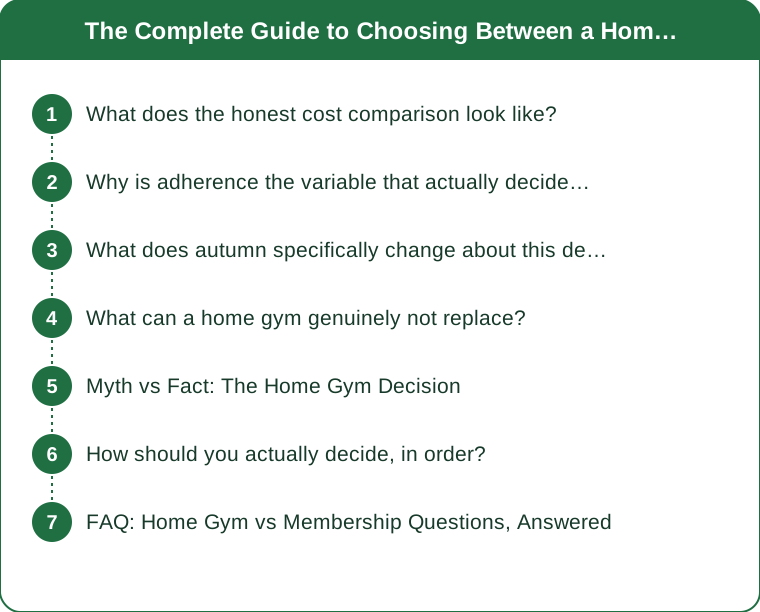
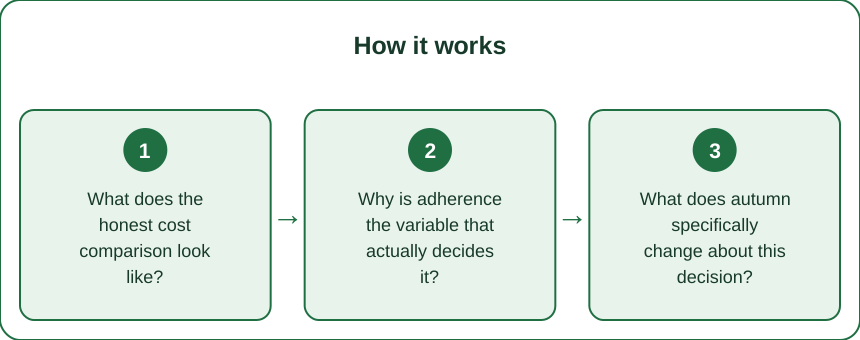
What does the honest cost comparison look like?
Both sides are routinely misrepresented, and the gap is smaller than either camp claims.
Gym membership costs, realistically: a budget chain in most markets runs 10 to 30 dollars monthly, a mid-range gym 40 to 80, and a boutique or full-service club 100 to 250 plus. Add the joining fee, which is typically 30 to 100 dollars, and the annual maintenance fee that many contracts include and most members forget.
Then add the costs nobody counts. Fuel or transit at even 3 dollars a round trip, three times a week, is around 470 dollars a year. Parking where applicable. And the biggest hidden cost: time. A 20 minute round trip three times weekly is 52 hours a year - more than a full working week.
Home gym costs, realistically. A genuinely capable general-fitness setup is adjustable dumbbells, a bench, a mat and bands, which is roughly 500 to 900 dollars new and considerably less used. Adding a rack, barbell and plates takes you to roughly 1,500 to 2,500. A cardio machine of decent quality adds 800 to 2,500 and is the item most likely to be regretted.
The home costs people leave out: flooring to protect the floor and reduce noise, 100 to 400. Increased heating or cooling in a garage. Electricity for a treadmill. And the resale reality - used equipment sells at 40 to 60 percent of new, which actually makes the downside smaller than it looks.
Break-even against a 50 dollar per month membership with a 900 dollar home setup is about 18 months, ignoring travel costs. Including travel and time valued at even minimum wage, it is closer to 10 months.
Why is adherence the variable that actually decides it?
Because a gym you attend twice a month is infinitely worse value than home equipment you use twice a week, at any price.
The cost analysis assumes equal usage on both sides. In reality, usage differs enormously by setup and by person, and gym attendance data is consistently sobering - a large share of members attend far less than they intended when they joined, and a meaningful proportion of memberships are essentially donations.
The determining question is what your actual failure mode is.
If your failure mode is friction - you skip because of the drive, the parking, the packing, the changing room, the wait for equipment, the weather - home training solves it almost completely. Removing a 20 minute round trip from a 45 minute session is not a marginal improvement; it changes the decision from a one hour commitment to a 30 minute one, and that is often the difference between doing it and not.
If your failure mode is motivation - you have the time and the equipment and you do not start - home training makes it worse. The gym provides environmental cues, social presence, sunk cost, and a physical separation between the training space and the sofa. Those are genuine behavioral supports and they are hard to replicate at home.
Be honest about which one you are. The evidence for this is in your own history: if you have previously owned equipment that went unused, you are the second type, and a home gym will fail again. If you have previously held a membership and stopped going because of the logistics, you are the first type.
A useful diagnostic: on a day you skip a session, what is the sentence you say to yourself? If it contains a logistical reason, you are a friction case. If it is about energy or motivation, you are not.
What does autumn specifically change about this decision?
Darkness, weather and the January price cycle all land in the next twelve weeks.
Daylight is the underrated one. Between late August and late October, evening daylight disappears rapidly in most temperate regions. Sessions that were a pleasant walk or run in September become a dark commute in November, and the drop-off in attendance that follows is well documented in gym usage data.
For home training, darkness is nearly irrelevant. For gym attendance it is one of the largest seasonal variables there is, and it is entirely predictable in advance.
Weather compounds it. Rain, cold and ice all add friction to the journey specifically, not to the training. If your failure mode is friction, autumn is when that failure mode gets significantly stronger.
The commercial cycle matters too. Gyms are at their emptiest and most negotiable in autumn, and at their most crowded and most expensive in January. Autumn joining offers are frequently better than New Year ones, and autumn is also when used equipment is cheapest - the second-hand market is flooded in September and October by people clearing out before winter, and it tightens sharply in January.
So the timing argument runs both ways, and it is a genuine argument for deciding now rather than in December: the used equipment market is at its best right now, and gym negotiating position is at its strongest right now. Both options are cheaper in October than they will be in January.
And there is a trial argument. Autumn gives you three months to test a decision before the January crowds arrive - which, if you choose a gym, is worth knowing about in advance.

What can a home gym genuinely not replace?
Four things, and how much they matter is entirely individual.
Heavy loading with safety. Training near maximal loads on squats and bench presses safely requires a rack with spotter arms and enough plates, which is the expensive end of a home setup. If your training is genuinely strength-focused at high percentages, a gym is meaningfully better and safer unless you invest at the top of the range.
Machine variety. Cable stacks, leg press, hack squat, plate-loaded machines - these provide loading patterns that are difficult to replicate with free weights, and they matter more for bodybuilding-style training, for rehabilitation, and for anyone whose joints tolerate machines better than free weights. A single functional trainer partly closes this gap and costs 1,000 to 3,000.
Specialist cardio. A rowing machine, an air bike, a proper treadmill, a pool. Any one of these is affordable at home; having the choice of all of them is not.
Social and instructional environment. Classes, other people, coaching, and the accountability of being seen. For a substantial number of people this is the entire value proposition, and no amount of home equipment substitutes for it.
The honest assessment: for general fitness, body composition and health, a home setup of adjustable dumbbells, a bench, bands and a mat covers most of what most people actually do. For competitive strength, for machine-dependent training, or for anyone who trains because other people are there, it does not.
Myth vs Fact: The Home Gym Decision
Myth: A home gym pays for itself in a year. Fact: Against a budget membership, often not for two to three years. Against a mid-range one with travel costs included, more like ten to eighteen months. The honest number depends heavily on what you buy and what you were paying, and anyone quoting a single figure is selling something.
Myth: You need a lot of space. Fact: A capable setup fits in about 6 by 8 feet. The bench and the space to lie down next to it is the actual footprint driver, and adjustable dumbbells replace an entire rack. Space is a much smaller constraint than most people assume - ceiling height for overhead pressing is the one to check.
Myth: Cheap equipment is a false economy. Fact: For some items yes, for others no. Cheap benches and cheap racks are genuinely a safety issue. Cheap mats, bands, and even basic plates are perfectly fine. Spend on the things that hold you or a load; save on everything else.
Myth: You will get bored training alone. Fact: Some people will. But the evidence on this is far less one-sided than gym marketing suggests, and the people who thrive at home are typically those who already train with headphones in and do not talk to anyone at the gym. If that describes your gym behavior, the social loss is theoretical.
Myth: Buying used is risky. Fact: For plates, dumbbells, kettlebells and racks, used is close to riskless - cast iron does not wear out. For treadmills and anything with a motor or electronics, used is genuinely risky. Split your buying accordingly.
How should you actually decide, in order?
Six questions, answered honestly, in this sequence.
1. What is your documented failure mode? Look at the last twelve months. Did you skip sessions for logistical reasons or motivational ones? This single answer should carry more weight than everything else combined.
2. What training do you actually do, not what you intend to do? If your last three months of training were dumbbells, bodyweight and a treadmill, a home setup covers it. If you were using four different machines and a cable stack, it does not.
3. What is your round trip time? Under 10 minutes, the friction argument for home is weak. Over 25 minutes, it is very strong. This is the number that moves the answer most for most people.
4. What is the real monthly cost including travel? Add fuel or transit, parking, and any fees. Compare it against a specific equipment list you have actually priced, not a hypothetical one.
5. Can you leave it set up? Equipment that must be assembled and put away each session has dramatically lower usage rates. A permanently set-up corner beats a better setup in a cupboard, and this is one of the most reliable predictors of whether home equipment gets used.
6. What is the hybrid option? This is the answer for a lot of people and it gets dismissed too quickly. A basic home setup for the two or three sessions a week where friction is the enemy, plus a budget membership for the heavy or machine-based session. Total cost is often lower than a mid-range membership alone, and it covers both failure modes.
Start smaller than you think. Adjustable dumbbells, a bench and a mat, used, for under 600 dollars. Train on it for eight weeks. If it gets used, expand. If it does not, you have learned something important cheaply, and cast iron holds its resale value better than almost anything else you could have bought.
FAQ: Home Gym vs Membership Questions, Answered
What is the single best first purchase for a home gym?
Adjustable dumbbells, by a wide margin. They cover pressing, rowing, squatting, hinging, carrying and single-limb work in one footprint, they scale for years, and they hold resale value. A bench is the second purchase and roughly doubles what the dumbbells can do. Everything after those two is refinement.
Is a treadmill worth it at home?
Only if you will actually use it, and the honest base rate is not encouraging - cardio machines are the most commonly abandoned home equipment. The cases where it works well are specific: bad weather regions, safety concerns about running in the dark, and parents who cannot leave the house. If those describe you, buy new rather than used, because motors and electronics are the risky part of the second-hand market.
How much space do I really need?
Roughly 6 by 8 feet of clear floor for a dumbbell and bench setup, plus room to lie down with arms extended. Check ceiling height if you plan to press overhead standing - 8 foot ceilings are tight for taller people with a barbell. Flooring matters more than square footage: horse stall mats or interlocking rubber protect the floor and reduce noise substantially.
Should I cancel my membership before or after I buy equipment?
After, and with an overlap of at least a month. The overlap costs one membership fee and prevents the common failure where equipment arrives, does not get used, and there is now no gym either. Cancel once you have eight consecutive weeks of home training behind you.
TL;DR:
- A capable home setup is 800 to 2,000 dollars and breaks even against a mid-range membership in 12 to 24 months - sooner once travel time counts.
- Decide on failure mode, not cost. Friction-driven skipping means home wins; motivation-driven skipping means the gym wins.
- Autumn is the right time: used equipment is cheapest now, gym offers are better than January, and darkness is about to make travel harder.
- Home cannot easily replace heavy safe loading, machine variety, specialist cardio and social accountability.
- Buy used for iron, new for motors. Cast iron does not wear out; treadmills do.
- Equipment that stays set up gets used. A permanent corner beats a better setup in a cupboard.
- The hybrid - basic home kit plus a budget membership - is the right answer more often than either pure option.
Start with adjustable dumbbells and a bench, train for eight weeks, and let the usage decide the rest.
See It in Motion
Seen here: High Waist 8” Yoga Shorts — shop it on bubblelime.com
Keep Reading
This article is for general informational and styling purposes only. Fit, sizing, and product availability may vary.