The Complete Guide to Home Gym Ventilation and Air Quality
Quick Answer: Home gym performance suffers most from stagnant air, rising humidity and heat that has nowhere to go — not from lack of equipment. The three fixes that matter are cross-ventilation (two openings, not one), a fan that moves air across you rather than around the room, and a dehumidifier in any garage or basement space. A single well-placed fan changes perceived effort more than most equipment purchases, and humidity control is what protects the equipment itself from rust.
Same workout. Same weights. Same you.
In the garage it feels like wading through soup, and you blame your fitness.
It is almost never your fitness. Here is what is actually happening in that room, and what to do about it in order of cost.
Why does a closed room make training so much harder?
Three things change simultaneously, and they compound each other.
Heat builds up with nowhere to go. A person training hard produces a substantial amount of heat — several hundred watts continuously, comparable to a small heater running in the room. In a large open gym that heat disperses into a big air volume and gets removed by mechanical ventilation. In a single-car garage or a spare bedroom, it accumulates in a much smaller volume, and the room temperature climbs measurably over a 45-minute session.
Humidity rises fast. Sweat evaporating into an enclosed space has nowhere to go, so relative humidity climbs steadily. This matters enormously because evaporative cooling is your primary mechanism for shedding heat, and it only works when the surrounding air can accept more moisture. As humidity rises, sweat stops evaporating and starts dripping — you lose the fluid without getting the cooling benefit.
Air movement across the skin stops. Even at identical temperature and humidity, still air feels significantly hotter than moving air, because a stagnant boundary layer of warm, saturated air forms right at your skin surface. Moving air strips that layer away and restores evaporation.
The result is a rising heart rate at unchanged workload, higher perceived effort, and a session that genuinely produces less quality work than the same session in a ventilated room. This is real physiology, not softness, and it is why the same programme feels completely different in the garage in August versus October.
Carbon dioxide accumulation is a smaller but real factor in tightly sealed rooms. Elevated indoor CO2 is associated with reduced cognitive performance and a feeling of stuffiness, and a closed spare room with a person breathing hard can reach meaningfully elevated levels within an hour.
What is cross-ventilation and why does one window not work?
Air needs somewhere to enter and somewhere to leave. A single opening gives it neither.
With one window open, air movement is minimal. There is no pressure differential driving flow, so you get a small amount of exchange at the opening and effectively nothing in the rest of the room. This is why opening the garage door alone often changes surprisingly little.
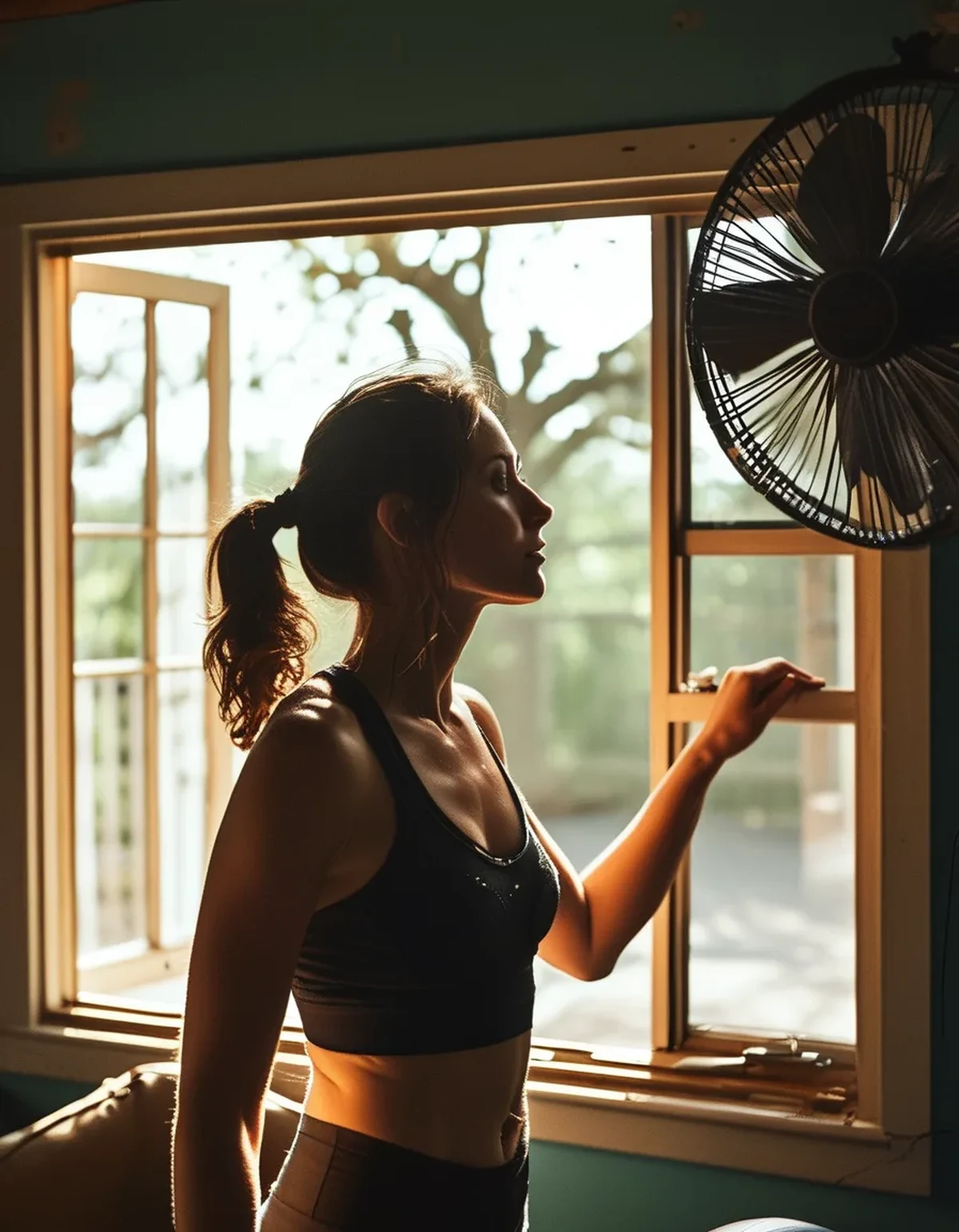
Two openings on opposite or adjacent walls create a genuine flow path. Air enters at one and exits at the other, and the whole room volume participates. A garage with the main door cracked and a side window or back door open behaves completely differently from one with just the main door up.
Placement matters more than opening size. Openings at different heights work particularly well, because warm air rises and exits high while cooler air enters low. A high vent plus a low opening produces passive flow with no fan at all.
Position yourself in the flow path, not beside it. The most common mistake is creating good cross-ventilation and then setting up the rack in the corner where the air does not travel. Stand where you can feel it.
In basements, this is harder and more important. Below-grade rooms often have limited or no openable windows, poor natural airflow and higher baseline humidity from the surrounding ground. A basement gym almost always needs mechanical help rather than passive ventilation.
Security and weather constrain this, particularly for garages. A lockable vent, a screened window or a partially open door with a security bar covers most situations, and it is worth solving properly rather than training in a sealed box.
How much difference does a fan actually make?
More than almost any other single purchase in a home gym, and it is the cheapest item on the list.
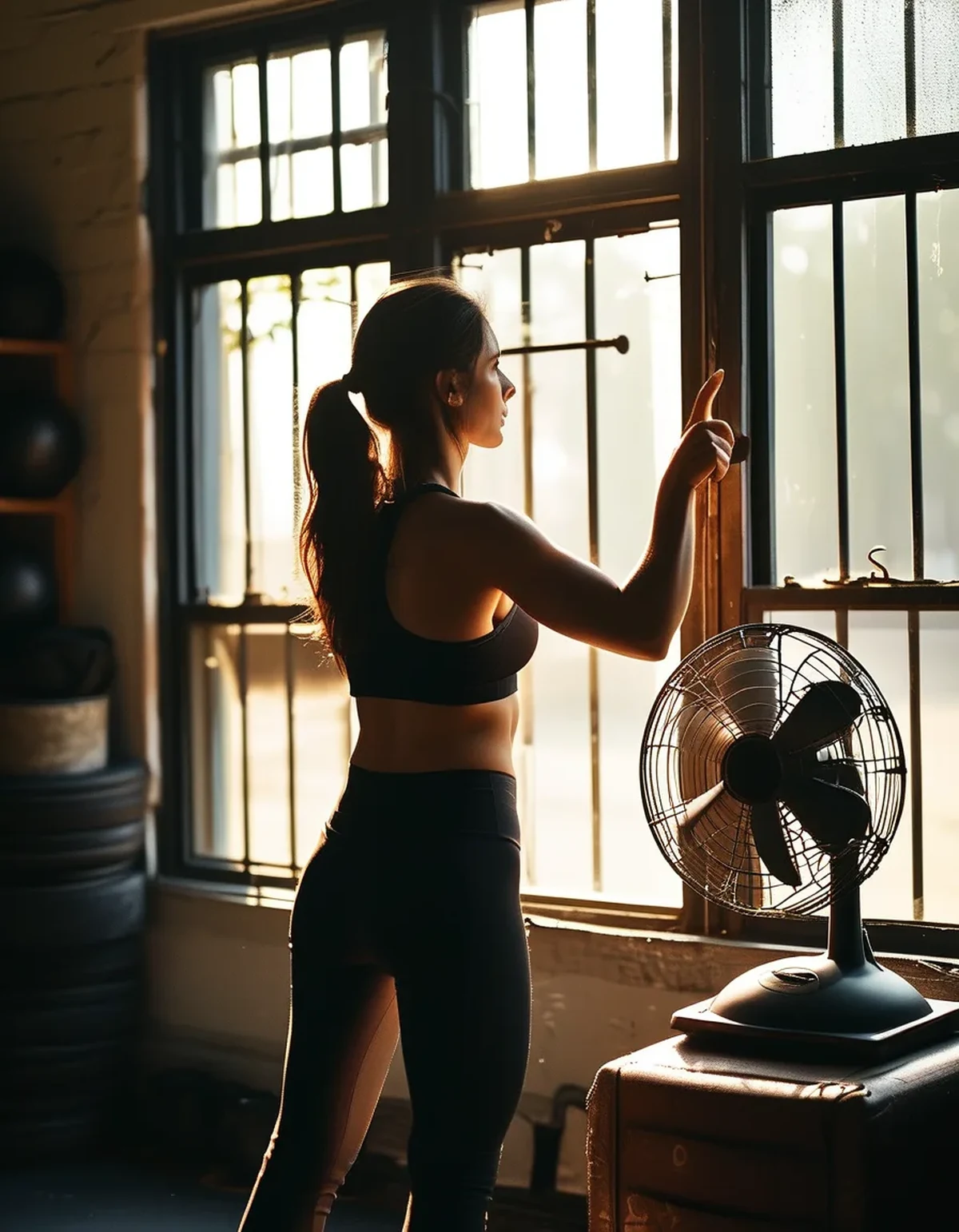
A fan does not cool the room — it cools you. It works by stripping away the saturated boundary layer at your skin and restoring evaporation. This is why a fan blowing across you feels dramatically better than the same fan circulating air in the corner, and why room temperature alone is a poor predictor of how a session will feel.
Direct the air at your torso, not your face. The torso has the largest surface area and the greatest sweat output. Face-directed air feels pleasant but does far less for actual heat dissipation.
Size and type matter for different purposes. A large-diameter, lower-speed fan moves more total air with less noise, which is preferable in shared or apartment settings. A high-velocity floor fan produces a stronger local effect on you specifically, which is what you want for hard conditioning work. Many home gyms benefit from one of each.
An exhaust fan solves a different problem. A fan blowing across you improves how the session feels but does nothing about the heat and humidity accumulating in the room. An exhaust fan in a window or wall, pushing air out while another opening lets fresh air in, actually removes the heat. For garages used year-round, this is the higher-value installation.
Noise is the constraint people underestimate. A powerful fan running for an hour in a small hard-surfaced room is genuinely loud, and in a shared house or apartment it becomes the reason you stop using it. Check the noise rating before buying, and favour larger, slower fans in noise-sensitive settings.
Test before you invest. Borrow or use any fan you already own for a week, positioned properly, before spending money. The difference is obvious within one session, and it tells you how much of your problem is airflow versus temperature.
What does humidity do to your equipment?
Rusts it, and faster than most people expect.
Bare steel corrodes readily above roughly 60 percent relative humidity, and garages and basements routinely sit well above that in summer. Barbell knurling, plate edges, rack uprights, dumbbell handles and any exposed steel surface are all vulnerable.
Sweat accelerates it dramatically. Salt is corrosive, and sweat left on a bar overnight in a humid garage produces visible rust remarkably quickly. Wiping down the bar after each session is the single highest-value maintenance habit in a home gym, and it takes fifteen seconds.
Bare steel bars need oil; coated bars need less. A light coat of oil on a bare steel or unfinished bar every few weeks, plus brushing the knurling to clear chalk and sweat residue, prevents nearly all of it. Stainless and coated bars are considerably more forgiving in humid environments and worth the premium if your space runs damp.
A dehumidifier is the systemic fix. Holding a garage or basement below about 50 percent relative humidity protects everything at once — equipment, flooring, stored items — and it also makes training meaningfully more comfortable, because it directly restores your ability to cool by evaporation. In damp climates this is arguably the highest-value appliance in the whole room.
Rubber flooring plus trapped moisture causes its own problems. Moisture that gets under rubber tiles on a concrete slab has nowhere to evaporate, which can produce mould and odour. Leaving a small perimeter gap and lifting tiles occasionally in humid seasons prevents it.
Watch the seasonal transition specifically. Late summer into early autumn is the highest-risk period in many climates, because warm humid air meets cooling surfaces and condenses. Metal equipment in an unheated garage can be visibly damp on an autumn morning even though nothing was spilled on it. Running a dehumidifier through this transition prevents a season’s worth of corrosion.
What about air quality beyond heat and humidity?
Several things accumulate in a closed training space that do not accumulate elsewhere in a house.
Rubber flooring off-gasses, particularly when new and warm. That distinctive new-gym smell is volatile organic compounds from recycled rubber, and it is strongest in the first weeks and on hot days. Ventilating aggressively during the first month, and choosing lower-odour flooring options where budget allows, both help. The smell diminishes substantially over time.
Chalk creates fine airborne dust. Magnesium carbonate particles stay suspended in still air and are irritating with regular exposure in an unventilated room. Liquid chalk eliminates the problem entirely and is worth considering in any small enclosed space.
Garages contain things you do not want to breathe hard next to. Stored petrol, solvents, paint, pesticides and a car engine that was running recently all contribute. Anything with a vehicle in the same space needs genuine ventilation before training, and a car should never be idled in an attached garage while anyone is in it — carbon monoxide is odourless and a CO detector in any attached garage gym is a sensible, inexpensive precaution.
Dust and allergens concentrate in low-traffic rooms. A spare room used only for training gets vacuumed less than the rest of the house while generating more airborne particulate from movement, flooring and chalk. A HEPA air purifier sized for the room handles this and helps considerably for anyone with allergies or asthma.
Mould is the basement-specific risk. Persistent humidity plus limited airflow plus organic material equals mould, and a gym adds moisture continuously. If a basement space smells musty, address that before adding equipment, because training hard in a mouldy room is a genuinely poor trade.
If you experience shortness of breath, wheezing or chest tightness that seems tied to training in a specific space, get it looked at rather than assuming it is deconditioning. This is general information, not medical advice.
What Nobody Tells You About Garage Gym Comfort
The room being unpleasant is the most common reason home gyms stop getting used, and almost nobody names it. People say they lost motivation. What actually happened is that the space became genuinely uncomfortable and the friction quietly rose above the threshold where they would rather go somewhere else or do nothing.
The comfort budget is tiny compared to the equipment budget, and it buys more adherence. A fan, a dehumidifier and a window vent cost a fraction of a single barbell, and they determine whether the room is usable for three of the four seasons.
Insulation is the upstream fix for both heat and cold. An uninsulated garage roof turns the space into an oven in summer and a freezer in winter. Insulating the roof and door is the highest-value structural change for a garage gym and it makes every other intervention work better.
Airflow needs change with the season, and the setup should too. Summer wants maximum exchange and direct air on you. Winter wants controlled exchange — you still need fresh air and humidity removal, but blasting cold air across a sweating body is how sessions become miserable. A fan you can reposition and openings you can partly close is more useful than any fixed installation.
Autumn is the ideal window to do this work. The weather is workable for installing a vent or insulating, the humid season is ending, and you have time before winter makes the room unusable in the other direction. Every garage gym that gets abandoned in January was set up in a pleasant month and never adapted.
Test the room, do not guess. An inexpensive temperature and humidity monitor left in the space for a fortnight tells you more than any amount of speculation, and it turns a vague sense that the room is stuffy into a specific number you can act on.
How do you set this up, in order?
Cheapest and highest-impact first.
Step 1: Measure. Put a cheap thermometer and hygrometer in the space for two weeks, checking before and after sessions. You are looking for temperature rise during a session and whether humidity sits above 60 percent. This costs almost nothing and directs everything else.
Step 2: Open two things. Establish cross-ventilation with whatever openings exist. Position your training area in the flow path. This is free and often produces the largest single improvement.
Step 3: Add a fan and point it at your torso. Use one you already own before buying. Judge the difference over a week of real sessions.
Step 4: Add a dehumidifier if humidity sits above 60 percent. In damp climates and basements this is not optional if you want equipment to survive. Size it to the room volume and empty it or plumb it to a drain.
Step 5: Add an exhaust path if heat is still accumulating. A window fan pushing out, with an intake opening elsewhere, actually removes heat rather than moving it around.
Step 6: Consider air filtration if you use chalk, have allergies, or the space doubles as storage.
Step 7: Insulate, if the space is a garage you intend to use year-round. This is the expensive one and it belongs last, but it is what turns a three-season room into a four-season one.
Maintain it: wipe the bar after every session, brush the knurling monthly, run the dehumidifier through humid transitions, and check under rubber flooring once or twice a year.
TL;DR:
- Stagnant air, rising humidity and trapped heat make sessions genuinely harder — it is physiology, not fitness.
- Cross-ventilation needs two openings. One window does almost nothing.
- A fan pointed at your torso changes perceived effort more than most equipment purchases.
- Keep humidity below about 50 to 60 percent or your bar and plates will rust, fast.
- Wipe the bar after every session. Fifteen seconds, and it is the best maintenance habit there is.
- Measure with a cheap thermometer and hygrometer first — then fix the specific problem you actually have.
Sort the air out this autumn and the room stays usable through winter, which is when most home gyms quietly get abandoned.
See It in Motion
Seen here: Racerback Tank Top - White — shop it on bubblelime.com
Keep Reading
This article is for general informational and styling purposes only. Fit, sizing, and product availability may vary.