The Complete Guide to a Home Gym in a Rental Without Losing Your Deposit
Quick Answer: Everything a renter needs comes down to four constraints: no permanent fixings, no floor damage, no noise complaints, and everything has to leave in a van. That rules out bolted racks, pull-up bars that screw into door frames, and glued flooring — but it leaves adjustable dumbbells, freestanding racks, horse-stall mats, and doorway bars that use a leverage mount. A genuinely capable rental gym costs roughly $600-1,200 and leaves no trace.
The standard home gym guide assumes you own the walls. Bolt the rack down, drill the pull-up bar into a stud, roll out rubber flooring and glue the seams.
Do any of that in a rental and you’re funding your landlord’s renovation out of your deposit. Here’s the version that works when the building isn’t yours.

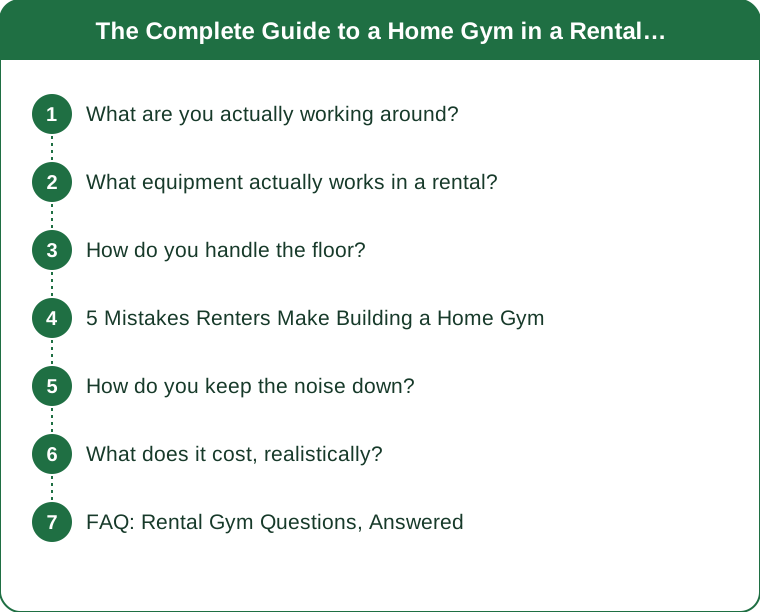
What are you actually working around?
Four constraints, and they’re worth naming precisely, because most rental gym advice solves one and ignores the rest.
No permanent fixings. Standard leases prohibit drilling into walls, ceilings, or floors without permission. This eliminates wall-mounted racks, ceiling-mounted rings, and screw-in pull-up bars. It also quietly eliminates most wall-mounted mirror installations, which is the compromise renters run into last.
No floor damage. This is the expensive one. Dropped weight cracks tile, dents hardwood, and compresses carpet permanently. In an upstairs unit it also transmits straight through the ceiling below. Most deposit disputes over home gyms come down to floor marks rather than walls.
Noise, and the neighbors it involves. In an apartment, this is not a nicety — repeated complaints can put a tenancy at risk. The problem isn’t lifting; it’s impact. Dropping weights, jumping, and treadmill footfall are the three things that travel through a building.
Everything has to move. A 700-pound rack is not going down two flights of stairs on moving day without help you’ll have to pay for. Weight and disassembly are real costs that owners never have to price in.
Worth knowing: load limits are rarely the binding constraint. Residential floors are typically engineered for distributed loads well above what a home gym imposes — the practical limits are noise and surface damage, not structural capacity. If you’re stacking several hundred pounds of plates in a single spot on an upper floor, it’s reasonable to spread it out along a load-bearing wall, but you’re solving a comfort problem more than a structural one.
What equipment actually works in a rental?
Order matters here — the first two items give you the most capability per dollar and per square foot.
Adjustable dumbbells (highest priority). A pair covering 5-50 lb per hand replaces an entire rack and occupies about two square feet. They handle presses, rows, squats, lunges, RDLs, and carries — which is most of a complete program. Expect $300-600 for a decent pair, and buy the dial or pin-selection type rather than the spin-collar version, since you’ll actually use them if changing weight takes three seconds.
Resistance bands with a door anchor. Cheap, silent, no floor impact, and they cover the pulling patterns that dumbbells handle awkwardly at home. A set with a door anchor runs $30-60 and travels in a drawer.
A doorway pull-up bar of the leverage type. This is the key distinction: the leverage-mount style braces against the frame using your own weight and requires no screws. The screw-in style is a fixing and will cost you. Check your frame is solid wood or a properly framed opening, and inspect for paint or trim damage after the first few uses — soft trim can mark even with the no-screw version.
A freestanding half rack or squat stands, if you’re serious about barbells. These sit on the floor under their own weight rather than bolting down. They’re less stable than a bolted rack, which means no failing a lift into the safeties as a routine practice — train with a margin. Squat stands break down for moving far more easily than a full rack.
An adjustable bench. Flat, incline, decline. Doubles as a step, a box, and a support for single-arm work.
What to skip: anything wall-mounted, anything requiring a permanent anchor, and — in an upstairs unit — treadmills and rowers, which are the two most common sources of noise complaints.
How do you handle the floor?
This is where the deposit lives, and where most renters underinvest.
Horse stall mats are the standard answer. Sold at farm supply stores, they’re typically 4x6 feet, three-quarters of an inch thick, and around $50-70 each. Two or three cover a training area. They’re heavy — roughly 100 lb apiece — which is a feature for stability and a problem on moving day. They protect against nearly everything short of a deliberately dropped barbell.
Interlocking foam tiles are the lightweight alternative at $2-4 per square foot. Fine for bodyweight work, dumbbells, and yoga. Not sufficient under heavy loading, and they compress permanently over time.
The layered approach, which is what actually works: interlocking foam as a base for the full area, with a stall mat on top where you lift. The foam handles sound transmission and protects the floor broadly; the mat takes impact. This is also the cheapest way to cover a large room.
Critical detail nobody mentions: put something under the flooring. Rubber mats can leach and stain light-colored vinyl, laminate, and some hardwood finishes over months of contact — and that stain is exactly the kind of permanent mark that costs a deposit. A layer of builder’s paper or a cheap canvas dropcloth underneath prevents it entirely and costs almost nothing.
For carpet: foam over carpet is unstable and unsafe for lifting. Use a sheet of plywood as a base, then mats on top. This gives you a level, firm surface and protects the carpet from compression.
Ventilate. Rubber flooring off-gasses noticeably for the first few weeks. Open a window, run a fan, and don’t set it up in a windowless room in the same week you plan to train hard in it.

5 Mistakes Renters Make Building a Home Gym
1. Buying a full power rack. It’s the aspirational purchase, and in a rental it’s the wrong one. It usually can’t be bolted, it dominates the room, it’s a two-person job to move, and squat stands do 90% of the same work at a third of the footprint.
2. Using a screw-in pull-up bar. The leverage-mount version exists specifically for this situation and costs the same. Screwing into a door frame is a fixing, it’s visible at inspection, and it’s a genuinely unnecessary risk.
3. Skipping the layer under the mats. Rubber staining a vinyl or laminate floor is the single most common way a careful renter still loses a deposit over a home gym. A dropcloth costs $8.
4. Buying a treadmill for an upstairs unit. Footfall on a treadmill deck transmits directly into the structure and it’s rhythmic, which makes it far more noticeable to neighbors than random noise. A bike or a rower on a mat is quieter, and an outdoor run is quieter still.
5. Not photographing the space beforehand. Take dated photos of the floor, walls, and door frames before anything goes in. If there’s a dispute at move-out, this ends it in thirty seconds. It’s the highest-value five minutes in this entire guide.
How do you keep the noise down?
Noise is the constraint most likely to end a rental gym early, and it splits into two types that need different solutions.
Impact noise — dropped weights, jumping, footfall — travels through the building structure and is the hard one. Mitigations that work:
- Never drop weights. Control them down. This alone solves the majority of the problem.
- Use rubber-coated or urethane dumbbells rather than bare iron. The difference when you set them down is substantial.
- Set weights down on a mat, not the bare floor, and place them rather than releasing them.
- Substitute for jumping. Step-ups replace box jumps; fast bodyweight squats replace jump squats. Nearly every plyometric has a low-impact analogue that delivers most of the training effect.
Airborne noise — music, fans, your own breathing — is the easy one. Soft furnishings, a rug outside the training area, and headphones handle it.
Timing matters as much as equipment. Most residential noise complaints are about hours, not volume. Training between 8am and 9pm is usually uncontroversial; 6am deadlifts in a converted building are a conversation you’ll eventually have.
The move worth making early: introduce yourself to whoever lives below you and tell them what you’re doing. It costs one awkward minute and converts an anonymous noise problem into a neighbor you can text. People tolerate far more from someone they’ve met.
What does it cost, realistically?
Three tiers, all of which leave nothing behind.
Starter — around $250-400
- Resistance band set with door anchor: $50
- Leverage-mount pull-up bar: $35
- Interlocking foam tiles, 50 sq ft: $120
- One adjustable kettlebell or a pair of moderate dumbbells: $150
Covers bodyweight progressions, pulling, and conditioning. This is a genuinely complete beginner setup, not a compromise.
Capable — around $700-1,100
- Adjustable dumbbells, 5-50 lb per hand: $450
- Adjustable bench: $180
- Two horse stall mats: $130
- Bands and pull-up bar: $85
This runs a full hypertrophy and general strength program indefinitely. For most people this is the ceiling of what a rental actually needs.
Barbell — add roughly $700-1,000
- Squat stands: $250
- Olympic barbell: $250
- 300 lb of plates: $400+
- Additional stall mats: $130
Only worth it if barbell work is central to your training, and think hard about the moving cost — 300 lb of plates is a real logistical problem twice.
Compare against a gym membership at $40-70 a month. The capable tier pays for itself in roughly 14-18 months, and adjustable dumbbells hold resale value well if you move somewhere with a gym in the building.
FAQ: Rental Gym Questions, Answered
Will my floor hold the weight?
Almost certainly. Residential floors are built for distributed loads well beyond what a home gym adds, and the practical limits you’ll hit are noise and surface damage first. If you’re stacking a lot of plates in one spot upstairs, spread them along a wall rather than piling them mid-room — but this is a comfort measure, not a structural rescue.
Do I need to tell my landlord?
Not usually, if nothing is fixed to the building and nothing is damaged. If you’re installing anything semi-permanent, or if your lease has a clause about heavy equipment, ask in writing and keep the reply. A landlord who said yes by email is worth more than one who said yes on the phone.
What about a mirror without drilling?
Leaning a large freestanding mirror against a wall works and moves easily. Adhesive mirror tiles are a deposit risk — removing them takes paint with them more often than not.
Is a folding treadmill quiet enough for upstairs?
Usually not. Folding refers to storage, not noise, and the footfall is the problem regardless of the frame. If cardio at home is essential upstairs, a bike or rower on a mat is a much safer bet with the neighbors.
TL;DR:
- Four constraints define a rental gym: no fixings, no floor damage, no noise, and it all has to move.
- Adjustable dumbbells plus bands plus a leverage-mount pull-up bar covers most training for under $600.
- Layer the floor — foam base, stall mat where you lift, and always a dropcloth underneath to prevent rubber staining.
- Control weights down rather than dropping them; that single habit solves most noise complaints.
- Photograph the space before anything goes in. It’s the cheapest deposit insurance available.
The constraint that feels most limiting — no permanent installation — turns out to matter least. Everything on the capable tier fits in a small van, and none of it leaves a mark. Start with the dumbbells and the flooring, and add from there only when a specific lift demands it.
See It in Motion
Seen here: Crewneck Short Sleeve Workout T-Shirt — shop it on bubblelime.com
Keep Reading
This article is for general informational and styling purposes only. Fit, sizing, and product availability may vary.